There are thousands of articles and tutorials about business card design online. Many templates are available in a variety of formats, including PSD, which appears to be the most popular version. But does that mean that you should create your cards in Photoshop? What about Illustrator , InDesign, or Microsoft Word? Which software program will give you the professional results you’re after?
As with anything else, the answer depends on your project specs. While you can work with Microsoft Word, I’m not going to cover this program as it’s certainly not the preferred tool for professional printing purposes. That said, each program in the Adobe Creative Suite comes with strengths and weaknesses, although you may combine platforms to compensate for these shortcomings. Newer versions of Photoshop and Illustrator (namely CS4 or higher) often act as standalone solutions; be aware that utilizing more than 1 instrument might lead to mistakes, especially for beginners.
When to Use Photoshop
Ah, Photoshop…the magical photo manipulation program we all know and love. The word photo in the name is not accident—despite the amazing effects, Photoshop remains the industry standard for photography and web design, i.e. not necessarily print design. Before you turn to Photoshop for business cards, ask yourself the following question:
Will my design contain a jpeg (an actual picture)?
Yes– If you intend to include a headshot, background image, etc., then Photoshop would be the place to start. Feel free to simply edit the JPEGs in Photoshop, and then export into another program, such as AI. It is worth noting that we don’t recommend photos in business cards. Reason being that unless you’ve got pro pictures, you probably won’t get the crisp, clear look you want. You can get away with a few photo elements, such as a head shot or picture of your storefront, but steer clear of image based backgrounds whenever possible.
No– Then Photoshop probably shouldn’t be your first choice, unless that’s the only program you’ve got. Why you ask? Since Photoshop works with pixels, some of your printed graphics may appear jagged. Text doesn’t render as well either in the pixel environment. As long as you’re ok with less than optimal results, you’ll be satisfied. And by less than optimal, I mean that there may be no issues whatsoever outside of being on the butt end of design snobbery.
Illustrator vs. In Design
Here’s where things get a little tougher. Both AI and ID play well with print. So how do you know which one’s right? Ask yourself another question:
Will my artwork be text based?
Yes– Choose InDesign. You’ll need to bring in elements, such as a logo, but you’ll have a much easier time arranging them into a clean layout. Your text will be razor sharp, too. As a bonus, you’ll have the ability to easily place files in the future even if you happen to update the originals in AI. This will help you keep things organized and improve your workflow.
No– Stick with Illustrator, at least for your primary graphic elements. You can always import vector art into ID when you’re done to build the layout.
Community Sound Off
I hope you find this information useful. For a much more indepth look into this topic, please review this detailed explanation here: Photoshop, Illustrator, or InDesign.
Do you have any questions about business card design? Disagree with any of the advice above? Let us know in the comments below!
We had so much fun interviewing designer Paul Biedermann that we decided to interview another talented graphics professional today. It’s my distinct pleasure to introduce you to an experienced digital artist and illustrator Mr. Daryl Slaton! I met Daryl on Twitter, and I was immediately impressed with his unique portfolio. Daryl’s work expands across media platforms, and he’s heavily into print as well as animation. It just so happens that Daryl agreed to lend his talents in a special greeting card giveaway just in time for Christmas. So read his thoughts below, and don’t forget to enter the giveaway!
Q1) Please give a brief rundown of your career.
My whimsical quest to match animals to new story ideas started in childhood when my favorite “splurge” was a ten cent Surprise Bag that contained a small toy, three pieces of penny candy, and another little surprise. From that magic came an active imagination for stories that later came alive with art and theatrical training. Then came a career in commercial art and digital display that paid bills but just wasn’t that much fun. My life partner and soon to be wife, publicist Louise Glickman was also looking to re-kindle her energetic spirit when we found each other. We will be married on Nov. 30.
Q2) Do you prefer to design for print or then web?
I have no preference. My mind is so fertile that I first think of a story and then develop characters that “tell” the story and can be used in print or on the web.
Q3) You call yourself a multimedia artist. Do you see a distinction between art and graphic design?
I am a multimedia artist who has created illustration, animation, character design and display for many of America’s Fortune 500 companies as well as smaller businesses and nonprofit organizations. Tails of Whimsy developed through my passion for animals and then the fanciful.
“Form follows function” is the mantra for my artistic adventures. Characters come alive along with their intended uses for stories, whether they be for print or animation, 2-D or 3-D, for ads, galleries, display or publicity purposes. The collection or story idea always comes first.
Q4) Do you always begin a project with hand drawings?
Yes. This is a skill I developed in childhood while visualizing my own tales. I read extensively and still do enjoy classic tales from Alice in Wonderland to Dracula. My daily routine includes newspapers, comic books, news and political commentary, cartoons on-line and print, and movies (especially Turner Classics.) Travel also impacts my stories and drawings. A good example is Wispenwood Whimsies that developed on a trip to Ireland (faeries and gnomes) and Northern England (home of Beatrix Potter).
Q5) What’s your preferred graphics software program?
I use Flash for both animation and drawing. I transfer hand drawings into Flash with a stylus and digitizing pad. Flash art is then exported and opened in Photoshop in order to enhance it.
Q6) What made you expand your site beyond animal art?
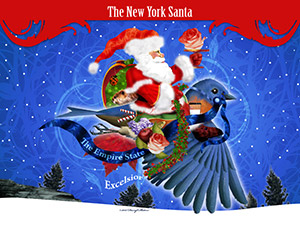
Our company name delivers our message: Tails of Whimsy. It forces people to ask, “Tails” vs. “Tales?” While the Whimsies or Santa Collections (State Santas and Santa Rides) focus on whimsical human figures and tell a story (tales), there is always an animal present (tails). Focusing into the future with branding opportunities, “The Art of Slaton” increasingly accompanies the name, “Tails of Whimsy.” It’s the name of our LLC.
Q7) What inspired your State Santa collection?
My ideas almost always develop in a context of learning. As a volunteer, I once helped children learn to read. I feel that the “magic” of the written word should provide an opportunity to communicate and that visuals reinforce these learning opportunities.
The first State Santa took “flight” in my studio in Asheville, North Carolina. The state symbols are embedded in the design and a legend accompanies the art. My partner Louise and I test marketed the State Santas at art fairs and some retail shops around North Carolina and found that parents and teachers turned the greeting cards into a guessing or learning game. Who knew we had a state “fruit?” Answer: the Scuppernong Grape!
RAZ Imports produced 24 State Santa images into glass ornaments this holiday and they may be found in retail stores nationwide. Also, glass Military and Service Santas are available honoring the four branches of the military, police and firemen.
Q8) Tell us about the exciting commercial projects you’re working on.
At Licensing Expo in Las Vegas in June 2013, Tails of Whimsy introduced five properties for publishing, animation, and products for the marketplace. These “groupings,” all with developed story lines, focused on children 2-12 and women, and included more than 150 images in collection format. The common thread is wildly colorful images all whimsical and fun but with varied styles of art. Utilizing illustrations, cartoon and photographic techniques, the range is so varied that licensees initially mistook Tails of Whimsy as a licensing agency with a stable of talent rather than the work done by one artist.
Some of this art is currently being licensed for holiday ornaments and Halloween dolls, over 36” high, and full of detail. Storybooks, retail products, and video and film projects are currently in negotiation for 2014.
Q9) How is social media helping your design business?
My partner Louise Glickman is concentrating on social media along with coordinator Tina Wolfe. There’s been a big learning curve to establish our brand across many social media platforms, but the response has been positive, and our followers are building.
My book agent J’net Smith (All Art Licensing) has helped us focus on opportunities for the BrokenHeart Pets, a story about the humorous and touching escapades of Scooter and Boots, a homeless and lovable dog and cat. The more followers we build for Scooter and Boots, the more likely our book will be published and produced as a series. In creating a fan club for Scooter and Boots, they will soon have their own fan page. Watch for cartoons and videos on YouTube.
Q10) Do you have any advice for young designers?
Yes. Find what you want to do most and a way to pursue it early. Building properties and collections to license takes years of time. Like most artists raising families, dreams get way laid because a good salaried position needs to take precedence between the ages of 20-50. It has taken a strong commitment to get into art licensing. On the other hand, our years of experience in meeting art deadlines and understanding art marketing has helped us build a strong following in a reasonable amount of time.
About Daryl Slaton
Daryl Slaton is an artist, designer, illustrator, and animator at Tails of Whimsy in Biltmore Lake, North Carolina. Connect with Daryl on Facebook, Twitter, and follow his blog.
The funky folks at Sappi Fine Paper will be hosting a free webinar tomorrow that the print community won’t want to miss—“Print &”! This production is part of the Paper cuts series provided by the Print Media Centr. There’s still time to register for the event, which takes place tomorrow, November 20th, 2013 from 1 – 2:30pm EST. The discussion should be of interest to any marketer as we’ll be talking about industry trends, consumer behavior, and ways to make print more interactive.
Our esteemed host, Daniel Dejan, brings a lot to the table. He serves as Creative Manager at Sappi, and he’s a certified G7 expert, which means he’s an expert in color management. With over 35 years in graphics and communications as well as numerous awards, you can be everyone will learn something from this seasoned veteran.
The Print & Integrated Marketing Book Freebie
Unless you signed up early along with me, you missed out on an unbelievable promotional book to browse as you follow along. I got my copy in the mail last week, and our entire staff gathered around in awe as we turned the pages in the break room. The book focuses on ROI in contemporary advertising, mainly how to integrate print into a multi-channel marketing campaign. Solid data drives the conclusion that mixed media allows marketers to capitalize on the strengths and weaknesses of different outreach methods better than single channel strategies. For instance, did you know that neuroscientists demonstrated consumers get higher emotional reactions when they’re given printed pieces? The act of being able to hold marketing materials in their hands leaves a “deeper footprint” in their brains than say, a flashing banner ad. This lasting impression explains why high end retailors and brands in luxury niches utilize print as their primary advertising tool.
But enough about that sales stuff—this is one sexy book. Every page presents a different, beautifully designed tactile experience. Best of all, the back cover features a fine fold that covers a list of the specs for each graphic. That way you don’t have to sit there and wonder HOW DID THEY DO IT? These details also make the examples seem attainable i.e. applicable for your own creative projects. So designers, the next time a client asks you to “make it pop!”, feel free to toss them a copy of Print &. They’ll be so distracted by the possibilities of print that they’ll forget about nonsensical requests.
Can I Still Get a Copy of Print &?
I’m not sure….according to this press release, Sappi clients may obtain a copy from their local sales reps. Members of the media should contact Joanna Rieke, or better yet, ask the Sappi people in person during tomorrow’s webinar!
You know you want to make custom calendars with your logo, but should your entire design focus on your company? That’s a tough branding decision that shouldn’t be taken lightly because your artwork will determine the success of the campaign. In some sectors, such as retail or apparel, you might be able to get away with producing a calendar that only features your products. For instance, a swimwear line would have no problem putting together an interesting calendar of models wearing bathing suits in exotic locations. An auto repair shop could get away with photos of luxury cars or a veterinary clinic can stick to adorable animal patients. Still, what about “boring” professions, such as accounting or construction? Is it best to stick with familiar themes or branch out using a universal angle?
Calendar Design Ideas for Ho-Hum Brands
I say as long as your calendar campaign messaging remains consistent with the rest of your branding, there’s no harm in stepping outside of your comfort zone a bit. For starters, write down a brief list of adjectives used to describe your brand. I already mentioned accounting, so let’s use this profession as our example. An accountant would probably describe his or her personal brand as trustworthy, knowledgeable, experienced, and accurate. What visuals come to mind when you read these words? How can you demonstrate these qualities in a way that connects with consumers?
Emphasize Family Planning- Many people do their own taxes while others prefer to find a professional because they want to plan for the future. If most of your clients have children, then find 12 months’ worth of financial tips for parents along with suitable stock photos of kids, happy families, etc.
Go Natural-Mother nature often leaves us in awe of her beauty, yet these scenes also convey a sense of stability. Choose a collection of calming images (i.e. a babbling brook, a beautiful blanket of snow on the mountains, a sunny tropical beach) and avoid anything that appears chaotic.
Show Your Personality- Do you have a hobby or another passion besides number crunching? Maybe you like outdoor sports or you love solving crossword puzzles. Take whatever you enjoy doing when you’re not working, and put into a truly personalized calendar that helps your clients get to know you better.
Entertain with Games – People enjoy playing trivia games and solving brain teasers. Why not display a different fun puzzle, math problem, or optical illusion each month? This idea would work really well for a desk calendar, although that requires more work on your part.
Community Sound Off
Hopefully one of the ideas above inspired you to get creative in 2014. Do you work for a bland brand? Have you ever designed an exciting promotional item for a surprising industry? Share your advertising tips in the comments below!
Hello everyone! Today we’re very pleased to present an interview with an accomplished graphics professional and true thought leader in the design community, Paul Biedermann. I met Paul on Google Plus, and I was instantly impressed with his online presence. He regularly shares interesting content,and exhibits expertise in content as well as social media marketing. I asked him if he’d share his wisdom with our readers on a variety of design and marketing topics in an exclusive Q & A. I hope you all enjoy the discussion—feel free to ask questions about anything you see below or share your thoughts. Now let’s dive in and hear what Paul has to say!
Paul Biedermann Talks Design, Marketing, and Results for Your Business
1) Can you give our readers a brief bio?
I am Creative Director/Owner of re:DESIGN, an award-winning boutique agency specializing in Strategic Design, Brand Identity, Visual Content Marketing and Communications.
Creating brands of distinction for profitable market advantage by driving real business results, I intersect smart design with business strategies that reach, engage, and inspire people to action — blending both traditional and leading-edge media tactics.
I talk a lot about the competitive advantage that design brings to power business in today’s busy media climate. This includes running the vibrant re:DESIGN Google+ community, speaking at media events and universities and having my articles appear regularly on AllTop, Ragan’s PR Daily, HolyKaw, Yahoo and Business2Community. I have also been featured in FastCompany, HubSpot, and New York’s Newsday. I am honored to appear on numerous “Best Of” lists, including the Top 100 Influencers in Social Media as well as being named in the top 1% of Influencers on Kred.
In my “spare” time, I am Managing Partner and Editor-in-Chief of 12 Most — the best list site on the web, providing daily thought leadership on business and media topics to a global audience.
My work background includes beginning my career at ABC Broadcasting before moving to a design agency that helped put ESPN on the map. As Art Director for the NFL, I created exciting new graphic approaches for the league during an explosive period of growth. As Creative Director for The McGraw-Hill Companies, I spearheaded design, marketing and advertising campaigns for global top-flight brands such as Standard & Poor’s, BusinessWeek, J.D. Power and Associates, Architectural Record, and McGraw-Hill Education.
2) You work in both web and print. Which medium do you prefer?
I do! I think an integrated approach is key for business, and that means paying attention to both online and offline. Every business is different, but just doing one and ignoring the other also means you are ignoring a segment of your market these days.
Web and print are different but similar too. I like that whatever is on the web is never really final — it can always be fixed, tweaked and added to. But therein also lies the challenge, because projects are never really “finished.”
With print, things are a bit more final, but that also has its challenges — and it never hurts to say a little “Hail Mary” when signing off on those printer proofs!
But my goal with most of the businesses I work with is to bridge both worlds — online and offline — for a seamless brand experience. In other words, from business card to website to social media page to event signage, there should be one consistent brand personality that comes across. Not many businesses walk that talk, but they need to!
3) You’re very active on social media, especially Google Plus. Do you think it’s more valuable for designers than LinkedIn or more design-specific sites i.e. Dribble?
All of the main social media platforms serve different functions — each has its pros and cons. I haven’t spent much time with the design-specific sites which I think are more like beauty pageants and the wrong way to hire design. But I think the key for social media is how you bring the different platforms together and balance out your time in a way that works best for your particular situation and goals. As I just stated about the importance of having an integrated approach for online and offline, the same is true for social media.
LinkedIn tends to be the least social of the lot, yet it is a great place to get insights into a person’s work background and to research companies. Every business needs to have a presence there. Facebook is more for friends and family in my opinion, and while bigger companies have success there, I think it is harder for smaller companies to gain traction.
Twitter on the other hand, is a great door opener to people and companies that you might not have a chance to meet otherwise, so I definitely make sure to spend time there, but you’re correct — Google+ is where I now put most of my energies. Besides being a great platform that brings together a lot of the best qualities of the other networks, the focused interaction you find on Google+ is unlike any other social network.
I also founded the re:DESIGN Google+ community which has become a great place to dig into the nitty-gritty of design and what it can do for business. It is for business and marketing people as much as it is for designers, and it’s a place where both sides can mingle, learn and cross-pollinate ideas — which ultimately leads to better work and THAT is really exciting!
4) You maintain an active blog; does writing help you improve your craft?
I think that writing is a very important business advantage these days, so if you can write compelling articles and post on the social networks in a way that draws people in, you have a leg up on the competition. Promoting your blog and sharing links to interesting, helpful content is a a powerful way to drive people to your website — so a blog becomes a critical component of many businesses’ marketing strategies these days.
And yes, writing does help my design too, as I think it helps clarify your thinking and that’s a good thing for your creativity. Comments on my blog and posts also challenge my thinking, so that can be very stimulating as well — the only thing to watch out for there is that you don’t get pulled down the rabbit hole and allow distractions to keep you from the work at hand. For many of us, that is the REAL challenge these days!
5) On your blog you said that content creation isn’t for everybody, and that’s ok. How can small business owners tell they need hired help for content marketing?
That’s a tricky one, because many businesses don’t know how bad their content really is. And it can also be difficult to tell them so without coming across as insulting, but it’s something they need to know.
Design, content and a solid branding strategy are often disregarded as “nice to haves” instead of mission critical. Many businesses think they are easy corners to cut and a cost savings by doing it themselves. This is also one of the reasons I write and share so much about design on the social networks — it’s sort of an educational service so people have a better understanding of what their businesses may be lacking, and what their branding, communications and marketing should aspire to be.
My hope is that maybe a few lightbulbs will go off and they’ll realize they need help and that design is, rather than a cost, a critical investment. Sometimes it works, sometimes it doesn’t — and sometimes you just have to tell them outright how bad they look and hope they’ll see how they are only hurting themselves, which never saves money.
It is incredibly competitive out there, and doing this stuff wrong is basically like shooting yourself in the foot every day — and that can have dire consequences for your business.
6) What’s the #1 design mistake small business owners make?
Um… not hiring a professional designer! The alternative is all-too-frequent and it is blatantly obvious with all the noise that’s out there. First impressions matter — so it’s important to make a good one quick!
There are so many tempting “low cost” alternatives these days: DIY online tools, cookie-cutter templates, crowdsourced solutions, and outsourcing to other countries with lower cost labor — but none of these approaches actually end up saving money because they prolong the time that a company isn’t taking advantage of all that good, effective design has to offer. These approaches: A) don’t produce unique work which is critical to stand apart from the competition and B) never consider the way that good design actually brings value to business.
More than just making something that looks nice, good design is part of an overarching strategy that is developed through a structured process that only comes from close collaboration between the designer and the client. There is back and forth — ideas are shared and designs evolve. Rather than thinking of projects as piecemeal one-offs, there should be a comprehensive strategy or at least an understanding about how your branding and communications fit into a larger picture.
7) Not everyone can afford a professional of your caliber. What do you recommend?
First, I would take an honest assessment and ask if the reason is that I can’t afford design or is it really that I don’t fully appreciate what it can do for my business so I tend to put my money elsewhere. I truly believe that if more people understood the impact that design can have on their business, they will find the money. They certainly find it for other critical needs.
Second, I would talk to a few designers (through recommendations from people you trust) — explain your goals and see if you can’t work out a plan and a budget that works for you. Once you understand how a designer works, you may have a better idea for how the process works and feel more comfortable working with someone who has your best interests in mind.
You will likely also see how an experienced designer will save you money too — perhaps making you aware of things that may have cost a pretty penny down the line that you didn’t foresee. For example, you may have been thinking you need three separate brochures, whereas a designer may suggest one piece with sections that would save on printing, and then perhaps suggest a pocket for inserts that can easily be updated rather than redoing an expensive piece when the information becomes outdated.
That old adage “pennywise, dollar foolish” is very applicable here — taking a low cost shortcut usually ends up costing more later.
8) You write a lot about trust in the designer/client relationship. What can designers do to increase the trust factor from the start?
I think designers need to listen and ask good questions that demonstrate an understanding of someone’s business challenges and a passion for helping their business succeed. I find that when I begin projects with new clients, I get excited about the possibilities that working together will bring to their business. This excitement translates into my work that will hopefully generate the same excitement in their markets, motivating them to act.
Of course, things like being upfront and meeting deadlines and staying on budget are also critical, but once you see that a person has your best interests at heart, how can you not trust them? The more trust there is, the better the work will be — and the more it snowballs.
About the Author
Paul Biedermann earned a BFA in Graphic Communications from Washington University in St. Louis. You can reach Paul through his website, blog and on Twitter, Facebook, Google+ and Pinterest
Since greeting cards appeal to both consumers and business owners, there are literally thousands of online templates available for free or a small fee. But that doesn’t mean they’re all created equal. Unfortunately, many of the cute designs you see are not intended for commercial printing. They’re simple DIY solutions that work fine for family and friends i.e. not in a professional setting.So while you may turn to Pinterest for inspiration, be very careful about where you get corporate card templates. Your business reputation depends on it!
How to Spot a Print Ready File
We found several fine examples of editable greeting card PSDs as well as vectors from reputable graphics resources, yet some of these still aren’t properly formatted for print. For example, Xerox offers a wide selection of free high resolution PDF card designs for Christmas, New Years, and Hannukah cards. Although they’re the right resolution, they’re in the wrong color mode, which means you have to switch to CMYK yourself. Before you send anything off to your printer, do a quick prepress check yourself. Here are the things you need to watch out for:
Resolution: 300 dpi or higher
Color Mode: CMYK
Measurements: This part is pretty tricky because you need a full bleed, and you need to know where the fold will be (unless you’re making flat cards). 99% of the free online templates are not that detailed. Fortunately, we have free blank templates in various sizes you can download on our site. If you need a print ready PSD, AI, PDF, etc. for your artwork, just click here.
Where Can I Find Christmas Card Templates for My Business?
Let’s say you don’t want to fool around with purchasing a premade design or getting a custom job from a graphic artist—you just want to be able to grab a nice looking graphic, throw your company name on it, and send the file off to print. I get it, you’re busy and want to move forward with the rest of your seasonal marketing plans.
Did you know we have a whole collection of beautiful holiday cards waiting for you? That’s right, we have everything from generic Happy Holidays to Merry Christmas, Happy Hanukah, and New Year’s. The templates are made for the two most popular sizes, 4″ x 6″ and 6″ x 9″, although there are far more in the smaller category. Now these are not the kind of fancy layered files you’ll find on GraphicRiver or a similar site. These are strictly for the non-designer who wants a fast, cheap, and easy solution that still looks pretty darn festive. Enjoy!
Christmas obviously means a lot to the Christian community, but Thanksgiving is also a big opportunity for local outreach. Few other holidays represent core Christian values of generosity, sacrifice, and gratitude for life’s many blessings. Your church probably hosts a special Thanksgiving service and participates in programs to help the less fortunate. You can use different forms of business signage from vinyl and roll up banners to custom posters to spread the Word about your seasonal events.
Religious Banner Design Inspiration
Your graphics should enhance your message, so it’s important to think about what you’re trying to accomplish with your banners. You also need to figure out whether you want to use outdoor signs or stay indoors. For outdoor materials, you should use simple text with big fonts that will be easy to read from far away. For example, script fonts tend to have thin letters, which makes them difficult to decipher. The banner examples below will give you a better idea of what will work in print.
This design comes from a web banner, so the artwork would have to be modified a bit for printing. I included the example because I love the creative approach. The adorable owl surrounded by classic fall colors gives off a fun, family-friendly vibe. I would recommend larger text in a stronger shade. The white here appears to be a bit subdued, and the style would not work very well in ink.
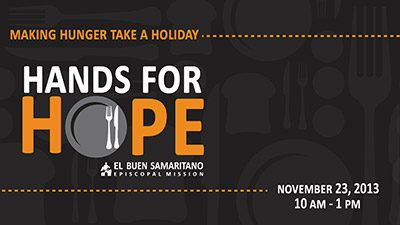
This is a fine example of a non-traditional direction to attract attention. Instead of the typical turkey dinner scene, this visually represents the message of hope. The orange and white text against a dark gray background looks attractive, inviting, and very clear. The only thing I’d add would be a call to action. The words “joins us” above the event date would do the trick.
This inner city ministry focuses on at risk youth, which can be seen in the unconventional graffiti font choice in the logo. The banner appears pretty straightforward, yet I see a nice visual metaphor for community service in the large spoon. The words, “volunteer sign-ups” function as a call to action, so they would need to stand out more with an eye-catching color.
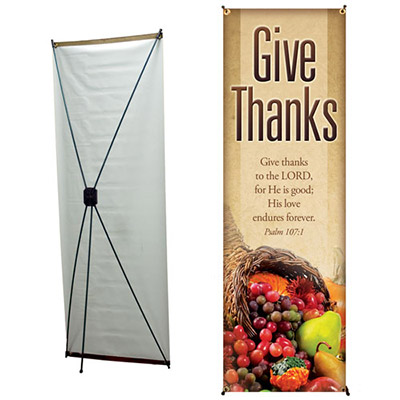
This roll up banner quotes Psalm 107:1, but numerous pieces of scripture would be applicable for this purpose. As long as the message focuses on being grateful to God, you’re free to choose your favorite verse. In this example, the cornucopia complements the message by alluding to the Thanksgiving feast.
Community Sound Off
Are you creating banners for your Church? Do you have any questions about signage? Ask us in the comments below!
Every Door Direct Mail and Small Business Saturday is a match made in marketing heaven. Why do I have so much confidence in this advertising solution? Allow me to explain.
What the Heck is EDDM?
Every Door Direct Mail (EDDM) is an affordable mass mailing program provided by the USPS. Think of EDDM as direct mail version 2.0 for your store. The old version took a lot of work. You had to create a big mailing list or purchase one from a broker. Each piece had to be printed with a unique address label, and you needed a special permit, which increased overhead costs. To top it off, the post office charged more for large mailers. Most small biz owners stuck to small 4″ x 6″ size postcards to keep costs down at the expense of ROI.
EDDM eliminates these barriers along with the inflated costs. You no longer need lists, individual labels, or permits (at least not for the retail version). You simply search for customers who fit your target market by zip code, intersection, income, etc., and send mailers to entire postal carrier routes. Best of all, there’s no additional cost for going big! You pay just 16 cents apiece for your mailers as long as they stay within the applicable size guidelines. That means 8.5″ x 11″ promotional postcards are finally within your budget.
Why Does EDDM Work for Local Businesses?
Everything comes down to ROI, which direct mail delivers for mom and pop shops. Consumer preference actually drives the success rate; 51% of consumers say they want to hear from local stores through the mail. It stands to reason that when you communicate in their favorite way, they’re inclined to respond. In fact, direct mail gets higher response rates (1.1-1.4%) than email (.03%), display ads(.04%), and paid search (.22%) combined. Direct mail also inspires consumers to act quickly; 79% act on direct mail immediately whereas only 45% respond to email right away. (Stats provided by the CMO Council).
Now let me be very clear—the more campaign channels you use to get the word out about Small Business Saturday, the better results you’ll get. Combine direct mail, email, and social media, you’re golden. But if you don’t have time to manage multiple mediums over the busiest time of year, then EDDM would be your best bet for local outreach.
Community Sound Off
How will you advertise for Nov. 30th aka Small Biz Saturday? Do you have any questions about EDDM, traditional direct mail, or marketing in general? Ask away in the comments below!
I’m going to pretend Thanksgiving doesn’t exist because there are plenty of other things going on in November besides this major holiday. Unless you’re a restaurant or a convenience store, you probably won’t be open on the 28th anyway.
You already know about Small Business Saturday, and I sincerely hope you’re planning to participate on November 30th. The ideas below should work for any independent retailer, and I’ll be doing a few follow up posts that focus on more specific niches i.e. restaurants, real estate, etc. Only 1 of these concepts relates to the Shop Small movement, and it can easily be modified for those who won’t be involved in this national celebration of mom and pop shops.
Please Don’t Eat Me!
11 Turkey Free Advertising Ideas
Observe Veteran’s Day (Nov. 11th) –Our soldiers deserve recognition all year around, but that’s another story. Many chain restaurants offer complementary meals for vets, which makes great material for a blog post or newsletter. The 11th falls on a Monday, so spend the whole week honoring our armed forces. There’s no reason to exclude active duty personnel from your discounts or sales. Every member of the military deserves special treatment for his or her sacrifice. Go the extra mile by visiting sick soldiers at the VA hospital or donate to your local VA chapter. Brighten a serviceman’s day with a gourmet fall gift basket, for example.
Write a Special Themed Newsletter- Speaking of newsletters, your customers probably enjoy non-promotional communication, such as email or physical newsletters. This format keeps your brand fresh in their minds, and gives you a chance to focus on fun for a change. Gather holiday recipes, find events of interest, share your best blog articles, etc.
Create Custom Holiday Greeting Cards- Ok, so this one doesn’t necessarily exclude Thanksgiving, although Christmas cards are more popular by far. Of course your clients will appreciate personalized thank you cards, although the point here is to get your ducks in a row before the Christmas madness begins. You’ll feel less stressed if you don’t wait until mid-December to get cards printed in a rush.
EDDM for Small Biz Saturday- Every Door Direct Mail would be the perfect choice for outreach in your neighborhood. Mass mail jumbo sized postcards about your Small Biz Saturday sale for only 16 cents a piece! Best of all, you don’t have to mess with mailing lists or address labels. Just find your customers by zip code, and send postcards to the whole carrier route.
Holiday Gift Guide Email Campaign – Follow up an EDDM campaign with an email blast to your current customers. Create a list of possible gift items from your store, and include several suggestions to suit different tastes or age groups. Use Word or another typing program to make branded shopping check lists for when the recipients visit your store.
Prepare Seasonal Packaging- Gift wrapping is a nice perk, although that’s not the kind of packaging I’m referring to. You’re bound to get first time buyers in December, so use your product packaging as a branding opportunity. Make custom labels, hang tags for clothing items, or print stickers with your logo to put on boxes or gift bags.
Celebrate Hanukkah (Nov. 27th)- Hannukah begins on the 27th, and lasts for 8 days. It’s not quite as important as Christmas is for Christians; still, there’ s no reason why you can’t embrace the rich traditions associated with the Festival of Light. Light a Menorah, bake sugar cookies to decorate with blue/white frosting, and don’t forget the jelly doughnuts! Leave a few chocolate gold coins by the register, too.
Black Friday Alternative-You know the mall will be absolute chaos the day after Thanksgiving. Highlight the difference between your store and the big chains by making your shop a place to escape the madness. Play soothing music, brew hot tea, and place a few extra chairs out if you have the space for shoppers to kick back in. Be sure to announce your plans in an email blast, blog post, and social media.
Post Happy Customers on Facebook-Photos bring people together online. Get your customers’ permission first, and take pictures of happy families enjoying your Hanukah treats or relaxing on Black Friday. You can post them everywhere, including Pinterest and Yelp, to stir up local interest. Optional: if any of the people are your personal friends, tag them in the pictures. If not, avoid this as it could be drawing unwanted attention.
Group Pinboard for Holiday Purchases- Got an active Pinterest following? Great! Make a special pin board for holiday moments. Invite your customers to pin their pictures on the board, but be very mindful not to post too many promotional items.
Give Back to the Community-There’s no better way to get in the spirit than by donating your time to help those in need. You can set up donation bins to collect clothing, canned food, etc. for local charities and match whatever you receive. If at all possible, go the extra mile by serving Christmas dinner at the soup kitchen, visiting the elderly, or doing clean up duty at the animal shelter. Pick a cause that’s important to you, and pitch in for the greater good. This suggestion isn’t exactly advertising, although it will drive positive word of mouth.
Now that Halloween is behind us, you’re probably already in full blown holiday marketing mode. Everyone knows about Black Friday, the annual uber hyped retail extravaganza that takes place on the day after Thanksgiving. Most stores report their highest profits during the Christmas shopping season, but it’s hard for mom and pop shops to compete with blowout sale prices at national chains. Major brands also have a natural advertising advantage this time of year; everywhere consumers turn, they’re bombarded with marketing messages from the big companies. Even local news outlets share crazy Black Friday stories, which indirectly promotes the corporate competition.
So what’s a local business to do to cash in on the Christmas madness? Celebrate Small Business Saturday on November 30th, 2013!
What is Small Business Saturday?
This year marks the 3rd Small Biz Saturday. Back in 2010, American Express Open teamed up with Facebook to create a special day dedicated to the backbone of the nation’s economy—local businesses like yours. Originally, the idea involved rallying American Express merchants by offering an incentive for customers who made a purchase at a participating location. The event was a smashing success, and the U.S. Senate officially recognized Small Biz Saturday 2011 to, “increase awareness of the value of locally owned small businesses.” (Source: Library of Congress) Each year, the shop small movement gains momentum, and lots of non-Amex clients jumped on board. Naturally, consumers welcome the chance to support the stores that contribute to the local community and character. Last year, shoppers spent an estimated 5.5 billion at neighborhood businesses, and they’ll likely buy more in 2013 due to moderate economic growth.
6 Ways to Start Promoting Today
There’s still plenty of time to participate in 2013, so here’s everything you need to move forward with your campaigns.
List your Business on the Shop Small Website by Nov. 4th! – I know, November 4th is today, so you’ll have to jump on this tip immediately. The Shop Small site provides an interactive map to help consumers find eligible stores in their area, so you’ll want to take advantage of this free advertising opportunity. Note: you must be an American Express merchant with a physical location in order to qualify.Click here to sign up today!
Get Organized Online – This year there are plenty of tools to bring local retailers together for awesome cross promotions. You can join a Shop Small community powered by Mightybell to find and collaborate with other entrepreneurs in your city. If there’s nobody on the site yet, you can invite your friends to connect there via email, Facebook, and LinkedIn. Step up to the plate and be a neighborhood leader, start your own community circle, and make magic happen in your town. Don’t know anybody around you? Now’s the perfect time for a few face to face meetings with the other store owners on the block. Visit the Shop Small Communities sitefor more information.
Plan Your Promotions- You don’t have to be an American Express user to spread the spirit. AmEx merchants may entice customers with special offers, but feel free to run your own discounts and sales. Remember, the goal is to emphasize personal connections along with the benefits of patronizing brick and mortar businesses. Consumers always appreciate lower prices, but be sure to think about what you can do to help the community. For example, our friends at West America Graphics are holding an educational session about the Adobe Creative Cloud for their clients as well as a canned food drive for Thanksgiving.
Business Signage- Let you customers know you’re participating on November 30th with in store signage. There are free generic and customizable signage templates on the official site plus marketing materials for your website, Facebook, Twitter, etc.
Social Media – speaking of social networking, Small Biz Saturday naturally involves online and offline interaction. You’ll get lots of tips by following the @ShopSmall account on Twitter, liking the Shop Small Facebook page, and discussing ideas on LinkedIn or Google Plus. Use the #shopsmall hashtag in your posts, and check the associated streams to expand your list of professional contacts. If you already participated in the past, submit your story on Facebook for a chance to be featured on the page!
Blogging- Sharing content on social media is great, so why not bring some of that activity onto your own site? You can post anything related to the event from your story to your plans and information about other cool stores in your area. Your efforts might increase traffic because there will be a lot of searches on this topic. As an added bonus, blog articles automatically give you material for your social communities.
Community Sound Off
How will you be celebrating on November 30th? Are you teaming up with you neighbors for a big cross promotion? Share your plans in the comments below!